
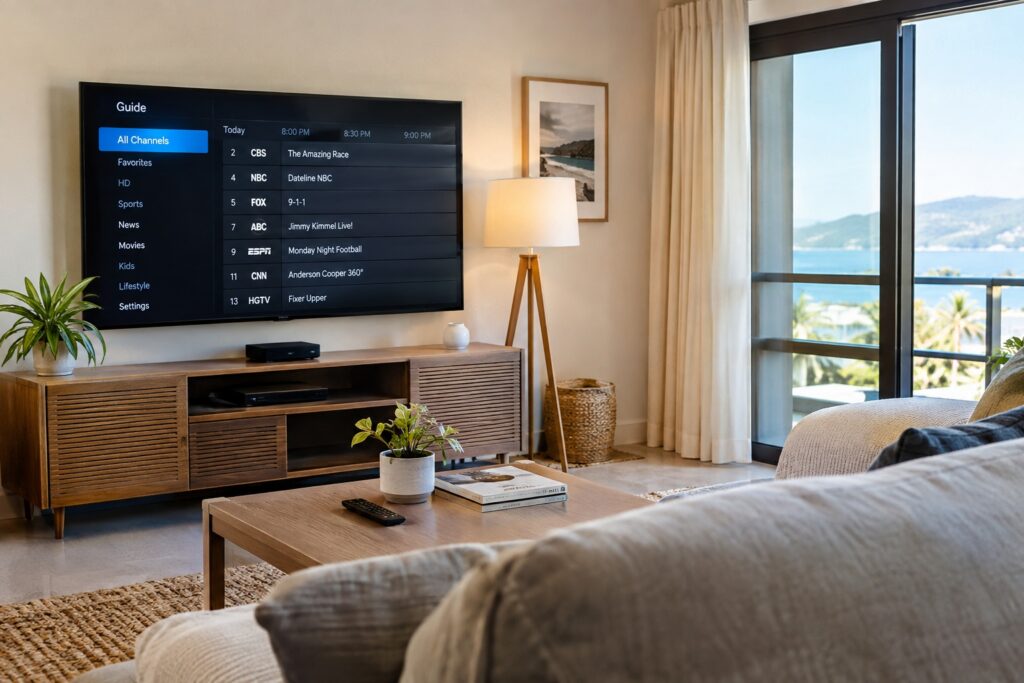
At first, cable TV seems simple.
You choose a package, connect it to the television, and your guests have something to watch.
Done.
But for vacation rental owners, the real cost of cable isn’t always the monthly bill.
It’s everything that comes with it.
Recurring subscriptions. Equipment. Installation. Service calls. Outdated channel packages. Guest complaints. And a TV experience that may no longer match what today’s travelers expect.
For hosts managing one property, these costs can be easy to overlook.
For owners managing multiple properties, they can add up quickly.
So, is traditional cable still worth the expense?
Let’s take a closer look.
Cable TV Is More Than a Monthly Subscription
When property owners think about cable costs, they usually think about one number:
The monthly bill.
But the actual cost can include much more.
Depending on the provider and property, owners may also deal with:
- Installation fees
- Equipment or receiver costs
- Additional boxes
- Service charges
- Channel package upgrades
- Replacement equipment
- Technician visits
- Contract commitments
- Multiple subscriptions across properties
The monthly subscription is only part of the equation.
And unlike a one-time purchase, cable is a recurring expense.
Every month.
Every property.
Every TV.
Multiple Properties Can Multiply the Cost
For a single vacation rental, a cable subscription might seem manageable.
But consider a property manager with 20 properties.
If every property has its own cable service, the expense doesn’t stay small.
There may also be multiple televisions within each property.
Now you’re managing multiple accounts, devices, subscriptions, and service arrangements.
The more properties you operate, the more difficult it becomes to keep everything consistent.
And that’s where cable can become an operational headache—not just an entertainment expense.
Guests Don’t Watch Cable the Way They Used To
There’s another issue.
The way people consume entertainment has changed.
At home, many travelers are already accustomed to streaming platforms and on-demand content.
They choose what they want to watch.
They watch when they want.
They often move between devices without thinking about it.
Then they arrive at a vacation rental and encounter a traditional cable box with hundreds of channels they don’t recognize.
For some guests, that’s perfectly fine.
For others, it feels outdated.
They’re not necessarily asking for more channels.
They’re asking for easier entertainment.
Guests Want to Watch What They Already Know
Imagine arriving at a vacation rental after a long day of travel.
You turn on the TV.
Instead of scrolling through unfamiliar channels, you want to open the streaming services you already use.
That’s increasingly the expectation.
Guests may want access to services such as:
- YouTube
- Netflix
- Hulu
- Disney+
- Prime Video
- Other popular streaming apps
The exact services vary by guest, of course.
But the larger trend is clear:
People are becoming accustomed to choosing their own entertainment.
A vacation rental TV needs to fit into that behavior rather than fight against it.
Cable Can Create a Poorer Guest Experience
The problem with traditional cable isn’t simply that it’s old technology.
It’s that the experience can create unnecessary friction.
Guests may have to figure out:
- Which remote controls the TV
- Which remote controls the cable box
- How to find the right input
- How to navigate the channel guide
- Which channels are included
- How to switch between cable and streaming devices
Even small frustrations can affect how guests perceive a property.
And when guests are paying for a comfortable, convenient stay, those little frustrations matter.
Printed Instructions Don’t Solve the Problem
Some hosts respond by creating detailed instructions.
“Press this button.”
“Switch to this input.”
“Use this remote.”
“Go to this menu.”
Before long, the TV comes with its own instruction manual.
That’s not exactly the experience most property owners want to create.
A modern guest experience should feel intuitive.
Guests shouldn’t need a tutorial just to watch television.
Cable Also Limits Flexibility
Another hidden cost is flexibility.
Traditional cable packages are generally designed around predefined channel bundles.
But your guests aren’t all the same.
One guest might want sports.
Another might want news.
A family might want children’s programming.
Someone else may simply want Netflix after a long day.
Trying to satisfy every preference through a traditional cable package can become expensive without necessarily improving the experience.
Streaming and connected TV technology provide a different approach.
Instead of paying for everything, guests can access the entertainment they already prefer.
What About Local Channels?
Local programming can still be important for guests.
News, weather, sports, and local broadcasts can all be useful while traveling.
That’s one reason property owners shouldn’t think of the choice as simply:
Cable or nothing.
Modern TV solutions can combine different types of entertainment and information into a single experience.
The goal is to give guests more useful choices without forcing property owners into increasingly expensive traditional packages.
Cable Can Also Be Difficult to Manage Across Properties
Now imagine you’re managing multiple vacation rentals.
One TV needs a service call.
Another has a missing remote.
A third property has a different cable package.
A fourth needs updated instructions.
Suddenly, entertainment becomes another operational task.
For property managers, centralized management can make a major difference.
Instead of physically visiting every property, modern connected TV platforms can allow content and settings to be managed remotely.
That can make updates much easier as a property portfolio grows.
The Cost Isn’t Just Financial
This is perhaps the most important point.
The hidden cost of traditional cable isn’t only money.
It’s also time.
Hosts and property managers already have plenty to manage:
- Guest communication
- Cleaning
- Maintenance
- Bookings
- Check-ins
- Checkouts
- Property updates
- Reviews
The last thing they need is another system that requires constant attention.
A better entertainment solution should simplify operations rather than add another task.
What Should Replace Traditional Cable?
The answer depends on the property.
But modern vacation rentals are increasingly looking toward connected TV solutions that combine entertainment with useful guest features.
Instead of providing only television channels, a property TV can become a centralized experience that includes:
- Streaming apps
- Live channels
- Personalized welcome messages
- Wi-Fi information
- Property instructions
- Local recommendations
- Guest promotions
This approach changes the role of the TV.
It’s no longer just an entertainment device.
It’s part of the property’s digital infrastructure.
A Smart TV Can Do More With the Same Screen
The biggest opportunity may be that property owners don’t necessarily need to change the entire room.
The television is already there.
The question is what you connect to it.
With the right platform, the same screen can help guests:
Watch.
Discover.
Connect.
Learn.
Relax.
And potentially discover relevant local businesses and offers.
That’s a much broader use of the same piece of hardware.
Where GuestBox Fits In
GuestBox is built specifically around this shift in vacation rental entertainment.
Rather than relying on a traditional cable experience, GuestBox uses dedicated hardware and a cloud-based platform to create a more flexible TV experience for properties.
Guests can access thousands of streaming apps, live channels, and games while also seeing personalized property information, welcome messages, Wi-Fi access, and local recommendations.
For hosts and property managers, the platform provides remote control over the guest TV experience.
That means the TV can become easier to manage while doing much more for the guest.
And unlike a simple app installed on an existing Smart TV, GuestBox is a dedicated device designed to remain part of the property’s TV experience.
The Real Question: What Are You Paying For?
Traditional cable gives you television programming.
But property owners should look beyond the channel count.
Ask what you’re actually getting for the total cost:
- Is it easy for guests to use?
- Does it support the way travelers consume entertainment today?
- Can you manage it remotely?
- Does it help improve the guest experience?
- Can it provide useful property information?
- Can it scale across multiple properties?
- Does it create opportunities beyond entertainment?
Those questions can reveal the difference between simply paying for TV and investing in a better guest experience.
Conclusion
Traditional cable isn’t necessarily disappearing overnight.
But the way guests consume entertainment has changed.
And vacation rental owners have to consider whether their TV experience has changed with it.
When you add up monthly subscriptions, equipment, maintenance, service calls, management time, and an increasingly outdated viewing experience, the true cost of traditional cable can be much higher than the bill suggests.
Modern connected TV solutions offer another path.
They can give guests more control over their entertainment while giving property owners a more flexible way to manage the experience.
The television is already part of your property.
The question is whether it’s simply costing you money—or helping you create a better stay.