
Running a vacation rental is a balancing act.
Guests want comfort, convenience, entertainment, and a smooth stay. At the same time, property owners have to manage cleaning, maintenance, utilities, subscriptions, supplies, technology, and other operating costs.
Cutting costs can help protect your margins.
But cutting the wrong things can quickly affect the guest experience.
The goal is not to spend less on everything.
It is to spend smarter on the things that matter most to guests.
Here are practical ways vacation rental hosts can reduce operating costs without making the property feel less comfortable or less professional.
1. Look at Your Recurring Expenses First
One of the easiest places to find savings is in recurring monthly expenses.
These might include:
- Cable or satellite TV
- Streaming subscriptions
- Internet and technology services
- Software subscriptions
- Property management tools
- Cleaning supplies
- Maintenance services
- Utilities
- Guest amenities
Small monthly charges can become significant over an entire year.
For example, a service that costs $50 per month represents $600 per year for one property.
Multiply that across several properties, and the number can become much larger.
Before removing a service, ask a simple question:
Does this expense actually improve the guest experience?
If the answer is no, it may be worth replacing or removing.
2. Don’t Cut the Amenities Guests Actually Notice
Not every expense should be treated equally.
Some amenities have a direct effect on how guests experience the property.
Comfortable beds, reliable Wi-Fi, a clean space, a functional kitchen, climate control, and easy access to entertainment can all contribute to a comfortable stay.
Cutting these simply to save money can create bigger problems later.
Instead, look for expenses that guests rarely notice.
The best savings often come from removing unnecessary costs rather than removing valuable amenities.
3. Replace Expensive Legacy Services
Some vacation rental expenses continue simply because they have always been there.
Traditional cable TV is a good example.
Hosts may pay recurring fees for channel packages, equipment, service, and multiple TVs even though many guests now use streaming services.
That does not necessarily mean you need to remove TV entertainment.
It may mean you need to rethink how you provide it.
A modern TV setup can give guests access to the entertainment they already expect while giving the property owner more control over the experience.
The important distinction is this:
Reduce the cost of the service — not the quality of the experience.
4. Use Technology to Reduce Repetitive Guest Questions
Guest questions take time.
And when you manage multiple properties, the same questions can appear again and again.
What’s the Wi-Fi password?
Where can I find the nearest grocery store?
What time is checkout?
How do I use the TV?
What restaurants are nearby?
Where can I find the house rules?
Instead of answering the same questions manually, put important information somewhere guests can access easily.
A digital guest guide, property website, automated message, QR code, or connected TV experience can make information available when guests need it.
This can reduce repetitive communication while making the stay easier for the guest.
5. Put Property Information Where Guests Already Look
A guest does not want to search through multiple messages to find basic information.
They want answers quickly.
That’s why the TV can be more than an entertainment device.
A property TV can display information such as:
- Wi-Fi details
- House rules
- Check-out instructions
- Local recommendations
- Property amenities
- Nearby restaurants
- Activities and attractions
- Welcome messages
When important information is easy to find, guests can solve simple questions themselves.
That saves time for the host without making the experience feel less personal.
In fact, it can make the property feel more organized.
6. Automate What Doesn’t Need to Be Manual
Manual work can become an invisible operating cost.
Updating information across properties, changing welcome messages, checking screens, managing content, and handling repetitive guest communication can take hours over time.
Automation can reduce some of that work.
For example, hosts can use technology to manage guest information, automate messages, update content, and control certain property systems remotely.
The goal isn’t to automate the entire guest relationship.
It’s to automate the repetitive parts so you can spend more time on the things that actually require your attention.
7. Manage Multiple Properties From One Place
Cost savings become even more important as your portfolio grows.
Managing one property is different from managing ten.
With multiple rentals, small inefficiencies multiply.
A technology platform that lets you manage TVs, content, branding, guest information, and settings from a central dashboard can reduce the need to manage each property individually.
Instead of visiting every property for small updates, you can make certain changes remotely.
That can save time, travel, and operational effort.
8. Make Your Existing Technology Work Harder
You don’t always need to buy something new to improve your property.
Sometimes you simply need to get more value from what you already have.
A television, for example, is already sitting in many vacation rental living rooms and bedrooms.
Instead of using it only for entertainment, it can become part of the guest experience.
It can welcome guests.
It can provide property information.
It can show local recommendations.
It can make streaming easier.
And with the right platform, it can even create opportunities for local advertising.
One piece of technology can serve multiple purposes.
That is a better approach than continually adding separate devices and services.
9. Give Guests Convenience Instead of More Stuff
Guest satisfaction does not always come from adding more physical amenities.
Sometimes it comes from making the existing experience easier.
A guest doesn’t necessarily need another printed guide.
They need the information inside it.
They don’t necessarily need dozens of complicated instructions.
They need a simple way to understand the property.
They don’t necessarily need an expensive entertainment package.
They need convenient access to the entertainment they enjoy.
Convenience can be an amenity.
And technology can help deliver it without requiring more physical items around the property.
10. Look for Savings That Improve the Experience
The best cost reductions can sometimes improve guest satisfaction at the same time.
Consider replacing:
Printed instructions → Digital property information
Manual updates → Remote management
Traditional cable → Modern connected TV entertainment
Repeated questions → Easily accessible answers
Property-by-property management → Centralized management
These changes aren’t about giving guests less.
They’re about delivering the same or greater convenience with fewer unnecessary processes.
11. Don’t Chase the Cheapest Option
There is an important difference between cost reduction and cost cutting.
Cost cutting asks:
“How can I spend less?”
Smart cost management asks:
“How can I get more value from what I spend?”
The second question is usually more useful.
Choosing the cheapest TV service, cleaning provider, software, or amenity isn’t always the right decision.
A cheaper option that creates more guest complaints, more maintenance, or more manual work can cost you more in the long run.
Look at the total value instead.
12. Think About the Guest Journey
A useful way to identify unnecessary expenses is to walk through the guest journey.
Start before arrival.
Then look at:
Booking → Pre-arrival → Check-in → First impression → Stay → Checkout → Review
At each stage, ask:
- What does the guest need?
- What causes confusion?
- What requires manual work?
- What costs money every month?
- What could be automated?
- What could be simplified?
- What can be removed without affecting the experience?
This can reveal opportunities that aren’t obvious when you’re only looking at a monthly expense report.
13. Consider the TV as Part of Your Property’s Experience
For many vacation rentals, the television is an overlooked piece of technology.
It’s already there.
It’s already connected to the room.
And guests already know how to use it.
The opportunity is to make it more useful.
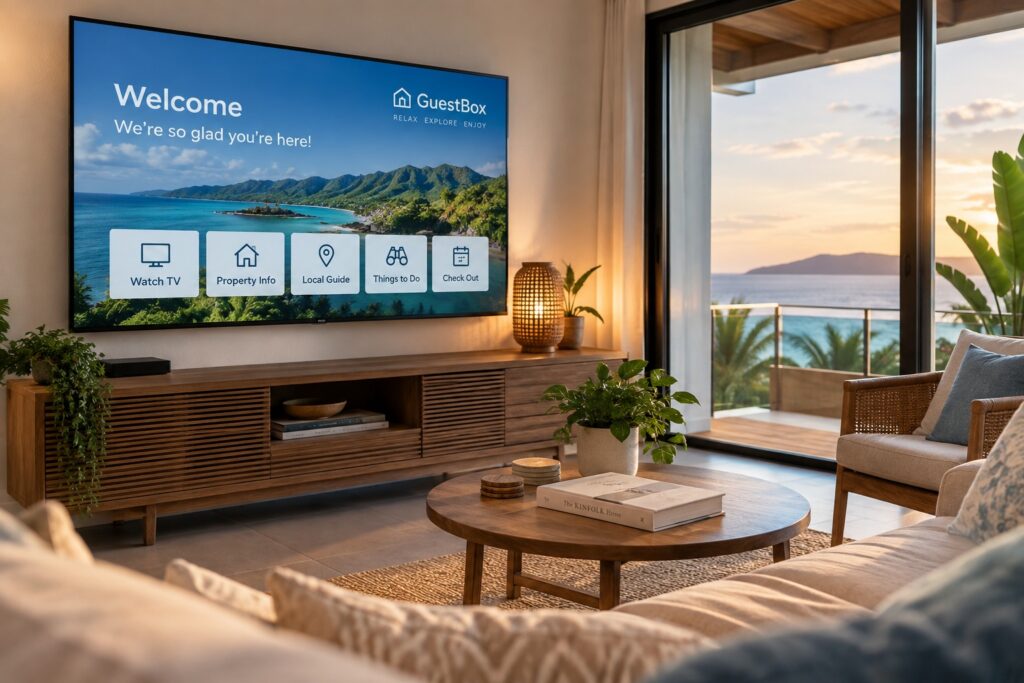
With a platform like GuestBox, property owners can turn the TV into a more personalized guest experience with streaming entertainment, welcome screens, property information, local recommendations, and other content.
The TV can become another way to help guests while reducing some of the repetitive work involved in managing a property.
And because GuestBox combines the TV hardware with a cloud-based management platform, hosts can manage supported content and settings remotely across their properties.
14. The Goal Is a Better Property, Not Just a Cheaper Property
Reducing expenses shouldn’t make a vacation rental feel cheaper.
It should make the business more efficient.
That means finding unnecessary recurring costs, simplifying operations, automating repetitive tasks, and making existing technology more useful.
The best savings are the ones guests don’t feel.
They simply experience a property that is:
- Easier to use
- Better organized
- More convenient
- More modern
- More consistent
That’s the real goal of smart cost management.
Spend less where guests don’t see the difference.
Invest where they do.
When vacation rental hosts approach costs this way, they can protect their margins without sacrificing the experience that keeps guests coming back.